
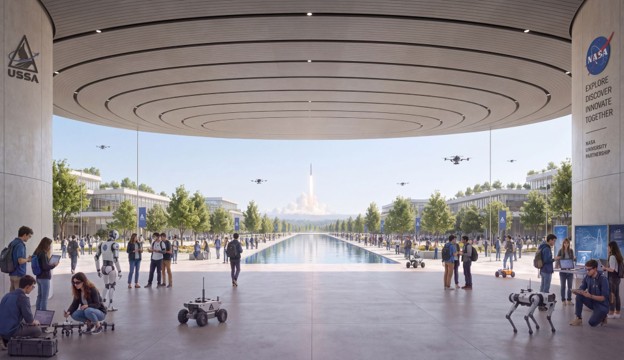
Florida officials have submitted a state response to NASA’s request for information proposing an interim campus for the United States Space Academy at the University of Central Florida (UCF) beginning in 2028, followed by a permanent campus on a 1,000-acre site at Kennedy Space Center (KSC) targeted to open in 2031.
Announced by Space Florida on Nov. 17, the two-part proposal calls for UCF to host an inaugural class of approximately 300 students in fall 2028, with support from Embry-Riddle Aeronautical University and the Space University Research Consortium. The plan calls for a permanent campus accommodating at least 1,200 students by fall 2031. Space Florida, the state’s independent aerospace finance and development authority, said the proposed KSC site could be made available through an amendment to its existing Launch and Landing Facility property agreement with NASA. State infrastructure investments and financing tools could also help reduce initial federal costs.
State and industry leaders framed the proposal around Florida’s existing aerospace infrastructure, university network and proximity to NASA, national security missions and commercial space operations. Space Florida noted that the state’s aerospace industry extends well beyond the Space Coast. Northwest Florida anchors defense aviation and engine manufacturing, while Central Florida leads in modeling, simulation and training (MS&T), and aerospace manufacturing.
“Florida is the nation’s leader in space exploration and innovation, and we have the infrastructure, workforce, and proven track record to ensure America remains at the forefront of the space industry,” Gov. Ron DeSantis said. “The new Space Academy belongs in Florida, and we are ready to help prepare the next generation of Americans to lead our nation’s efforts in space exploration.”
U.S. Sen. Ashley Moody argued that Florida’s existing space infrastructure gives the state an advantage over building competing facilities elsewhere. She said the Space Coast would give students a “front-row seat” to innovations from NASA and the private sector. “Why spend years and millions of dollars replicating what we’ve already built here? The U.S. Space Academy belongs in Florida,” Moody said.
In a joint letter to the Presidential Commission on the U.S. Space Academy, Florida Senate President Jim Boyd and Florida House Speaker Sam Garrison expressed support for the proposal, writing that the academy’s location would shape how quickly it could open. “Florida is ready to move at the pace this mission demands,” they wrote.
University and industry leaders emphasized the proposal’s potential to strengthen aerospace workforce development and regional economic ties.
UCF President Alexander N. Cartwright said the university is proud to support Florida’s proposal and is helping prepare “the leaders who will define our nation’s next era in space.” Embry-Riddle President P. Barry Butler highlighted the university’s more than 100-year history of training aviators, engineers and aerospace researchers. He added that the institution looks forward to supporting the academy’s first students.
“Florida has spent years building the financing tools, university partnerships and operational capability to stand up an institution like this, and that readiness means we can move quickly and efficiently,” said Rob Long, president and CEO of Space Florida.
U.S. Rep. Mike Haridopolos pointed to the convergence of NASA, national security missions and commercial space companies in the region. Gov.-elect Byron Donalds said the academy would train the nation’s aerospace workforce while creating “good-paying jobs for the Floridians who build our path to the stars.”
Local lawmakers also highlighted potential benefits for Brevard County, where Kennedy Space Center has operated for more than 60 years. State Sen. Debbie Mayfield said locating the academy in the county would create opportunities for the local economy, military installations, workforce and families. State Rep. Brian Hodgers said it would allow local students to train alongside active space operators.
Jeanette Nuñez, chair of the Space Florida Board of Directors, said the United States Space Academy deserves a home where students can gain firsthand experience alongside the operators, missions and institutions defining America’s place in aerospace. Florida Transportation Secretary Jared W. Perdue also cited the state’s infrastructure and talent base as assets that could support future space leaders.